
RAPID PROTOTYPING & End-use parts
Discover how Design for Additive Manufacturing (DfAM) transforms traditional manufacturing by enabling innovative designs, reducing weight, and enhancing efficiency.
Questions?
In the world of modern manufacturing, 3D printing has evolved far beyond a tool for rapid prototyping. Today, industrial additive manufacturing (AM) is producing end-use aerospace components, medical implants, and high-performance automotive & marine parts.
However, achieving success with 3D printing requires a fundamental shift in how we design. You cannot simply take a part designed for a CNC mill or injection molding and send it to a 3D printer. To truly unlock the power of 3D printing, you must design specifically for the process. This methodology is known as Design for Additive Manufacturing (DfAM).
In this comprehensive guide, we will break down what DfAM is, its core advantages, the critical constraints you must manage, and the digital tools you need to succeed.
Core Advantages of DfAM: Why Design for 3D Printing?
When you embrace the DfAM mindset, you move past the limitations of traditional manufacturing. Here are the four primary benefits of optimizing your designs for additive manufacturing:
1. Lightweighting via Advanced Structures
In industries like aerospace and automotive, every gram counts. DfAM allows you to replace solid internal volumes with highly engineered internal structures—such as lattices, honeycombs, or mathematically-driven gyroids. These structures dramatically shed weight while maintaining structural integrity and strength.
2. Part Consolidation
Traditional manufacturing often requires designing complex systems out of dozens of separate components, which must then be fastened, welded, or bolted together. DfAM enables part consolidation, combining multi-component assemblies into a single component. This eliminates weak points (fasteners/bonds), reduces failure points, drastically cuts down assembly labor, and streamlines your supply chain.
3. Geometric and Design Freedom
Because additive manufacturing builds layer-by-layer, it can create shapes that are impossible to machine conventionally. A prime example is conformal cooling channels—curved internal paths within injection molds or engine components that follow the exact geometry of the part. These optimize heat transfer in ways a straight drilled hole never could.
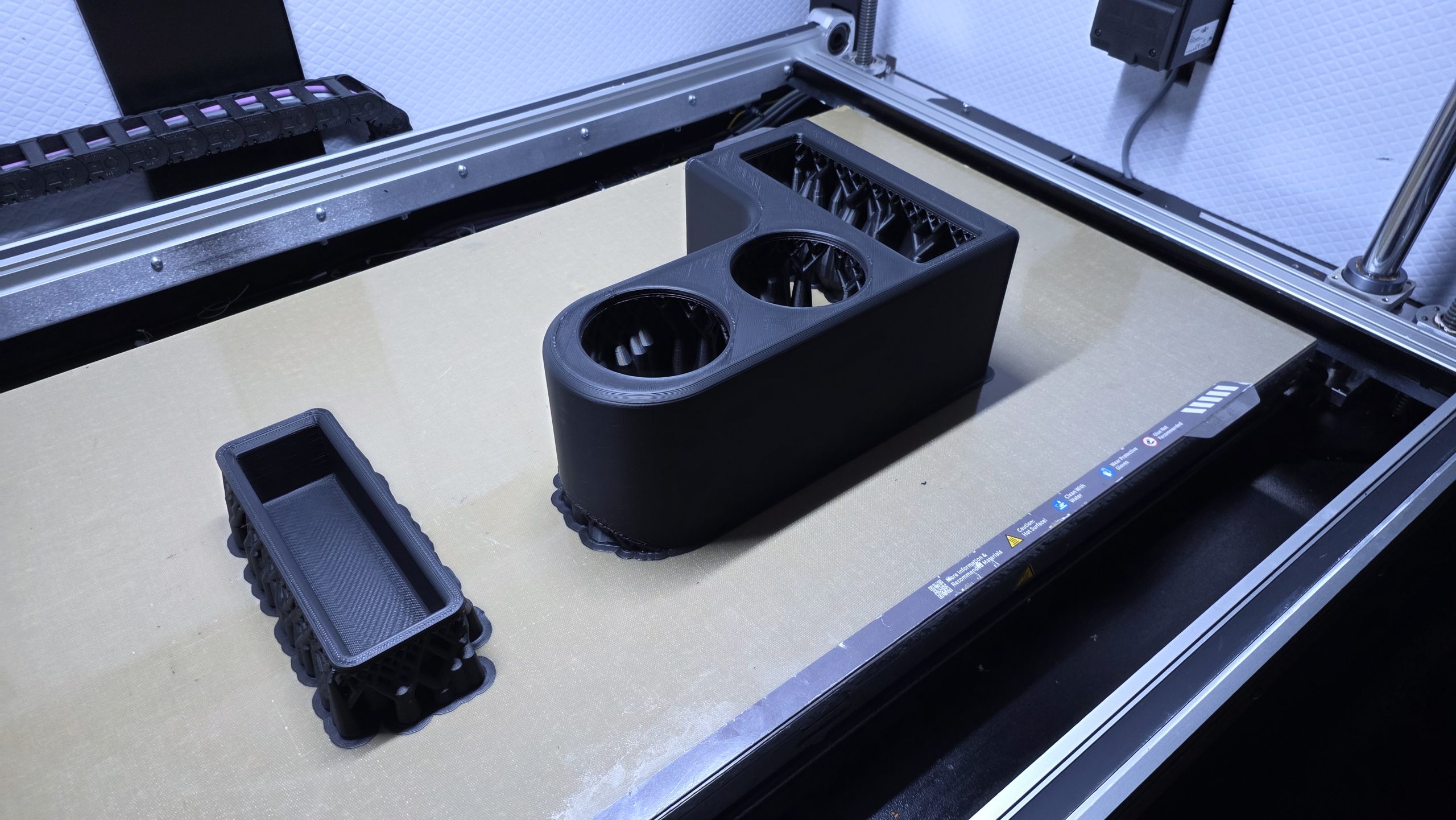

3D Printed by BigRep VIIO |
Center console for a Ford Thunderbird.
Key DfAM Constraints: Designing for Success
While 3D printing offers incredible geometric freedom, it is not magic. It comes with its own set of physics- and process-based limitations. To avoid print failures, warping, or skyrocketing post-processing costs, you must actively manage these four key design constraints:
1. Build Orientation
How a part is positioned on the print bed changes everything. Build orientation dictates the surface finish quality (due to stepping effects), the total print time, and the part's structural integrity. Because 3D printed parts are built in layers, they exhibit anisotropic mechanical properties—meaning they are typically weaker along the Z-axis (between layers) than in the X and Y axes.
2. Support Structures
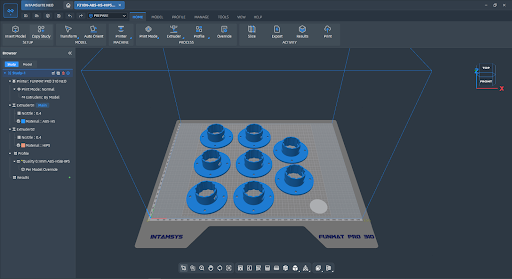
Overhanging features require temporary, sacrificial geometry called support structures to hold them up during the printing process. While supports are sometimes necessary, they come at a cost: they waste raw material, increase print time, and require labor-intensive, manual post-processing to remove. Good DfAM minimizes the need for supports through smart geometry.
3. Overhang Angles (The 45-Degree Rule)
As a general rule of thumb for many 3D printing technologies, features with overhang angles less than 45 degrees from the build plate require support structures to prevent sagging or printing into thin air. By designing self-supporting angles (such as teardrop shapes instead of round horizontal holes), you can eliminate the need for supports entirely.
4. Thermal Stress and Warping
As heated plastic or molten metal cools during the printing process, it experiences thermal contraction. If the cooling is uneven, internal thermal stresses build up, causing the part to warp, lift from the build plate, or crack. DfAM counters this by mandating uniform wall thicknesses, avoiding sharp corners, and designing features that allow for smart heat dissipation.
Understanding DfAM Constraints
While DfAM offers incredible design possibilities, it requires careful management of constraints like build orientation and support structures to ensure successful prints.
Explore how to optimize your designs by understanding the impact of thermal stress, overhang angles, and support structures on the final product.

Innovative Design
Efficient Production
Cost Reduction
Sustainable Solutions
Ensuring Printability with Digital Validation
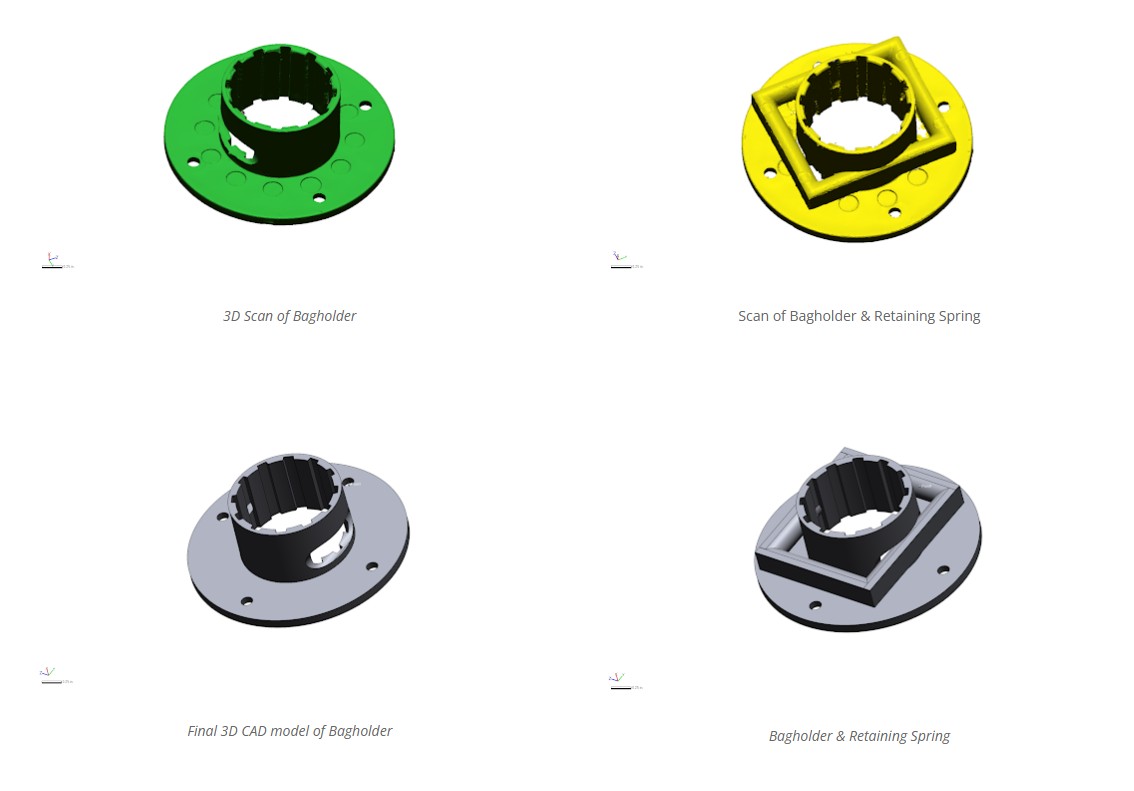
Before you send a file to the print bed, it must be digitally validated. Modern CAD systems and specialized optimization platforms are crucial for ensuring your design is actually printable.
-
Geomagic Design X: Widely trusted for reverse engineering and converting scan data into feature-based CAD models, it allows engineers to seamlessly transition real-world parts into a digital DfAM workflow.
-
Geomagic Control X: A powerful inspection platform that can validate printed parts against their original CAD data to ensure dimensional accuracy.
Dedicated software tools can simulate the entire printing process. They evaluate wall thicknesses, detect un-removable powder traps (crucial for powder-bed fusion technologies), simulate thermal distortion, and automate lattice creation—saving you thousands of dollars in failed physical prints.


What Are You Building Next?
The beauty of DfAM is that it is highly adaptable. The exact rules change depending on whether you are using Polymer Powder Bed Fusion (SLS), Stereolithography (SLA), Fused Deposition Modeling (FDM), or Direct Metal Laser Sintering (DMLS).
Are you currently working on a specific 3D printing project? Let us help you optimize it. Share details in the comments or reach out with:
- The 3D printing technology or material you plan to use (e.g., plastic vs. metal).
- The primary goal of your design (e.g., lightweighting, reducing assembly parts, or rapid prototyping).
With that information, we can define specific geometric rules, minimum wall thicknesses, and support-free angles tailored directly to your application!